
Start with your actual problem
You’re not choosing tech for fun — you need a system that survives bumps, weather, and tight schedules while giving useful footage. Think about daily operations, not specs on a spec sheet. If you manage deliveries or a mixed vehicle fleet, integrate this choice with your logistics fleet management goals: reduce incident investigation time, verify deliveries, and protect drivers. That focus makes the decision practical instead of theoretical.
What truly matters to your team
Prioritize these user-centered criteria before you get sucked into brand hype:- Reliability: solid build, wide temperature range, anti-vibration mounting.- Continuous uptime: ignition-sense recording and clean power handling so recordings never stop mid-route.- Storage strategy: how many days of footage at what resolution — plan with real drive hours.- Remote access: live view and event retrieval without needing to pull the drive.- Ease of use: firmware updates, simple GUIs, and remote diagnostics your tech team can actually handle.
Simple technical checklist (no fluff)
Match these specs to how you operate:- Video codec: H.265 for longer retention at the same quality.- Resolution & frame rate: 1080p at 15–30 fps per camera is usually enough for license-plate reads; bump frame rate for high-speed routes.- Bitrate policy: event-triggered high bitrate + lower constant bitrate saves space.- Storage type: industrial-grade SSD or ruggedized HDD with shock tolerance; always plan loop overwrite and event locking.- Inputs & outputs: at least one CAN or serial input if you need vehicle data, plus alarm inputs for door or panic triggers.- Power design: wide-range DC input, ignition trigger, and optional UPS for safe shutdown.- Environmental specs: operating temperature range and IP ratings for exposed installations.
Connectivity and remote management that save time
Remote access is what separates a tool from a solution. Look for:- Dual-SIM 4G/5G modems or optional Wi‑Fi offload.- Efficient streaming: adaptive bitrate, secure tunnels, and AES encryption.- Centralized fleet portal: remote firmware updates, event tagging, and easy download.These features tie directly into broader logistics fleet management solutions, so you don’t end up with a DVR that isolates footage from the rest of your systems.
Installation and daily operation — avoid the usual traps
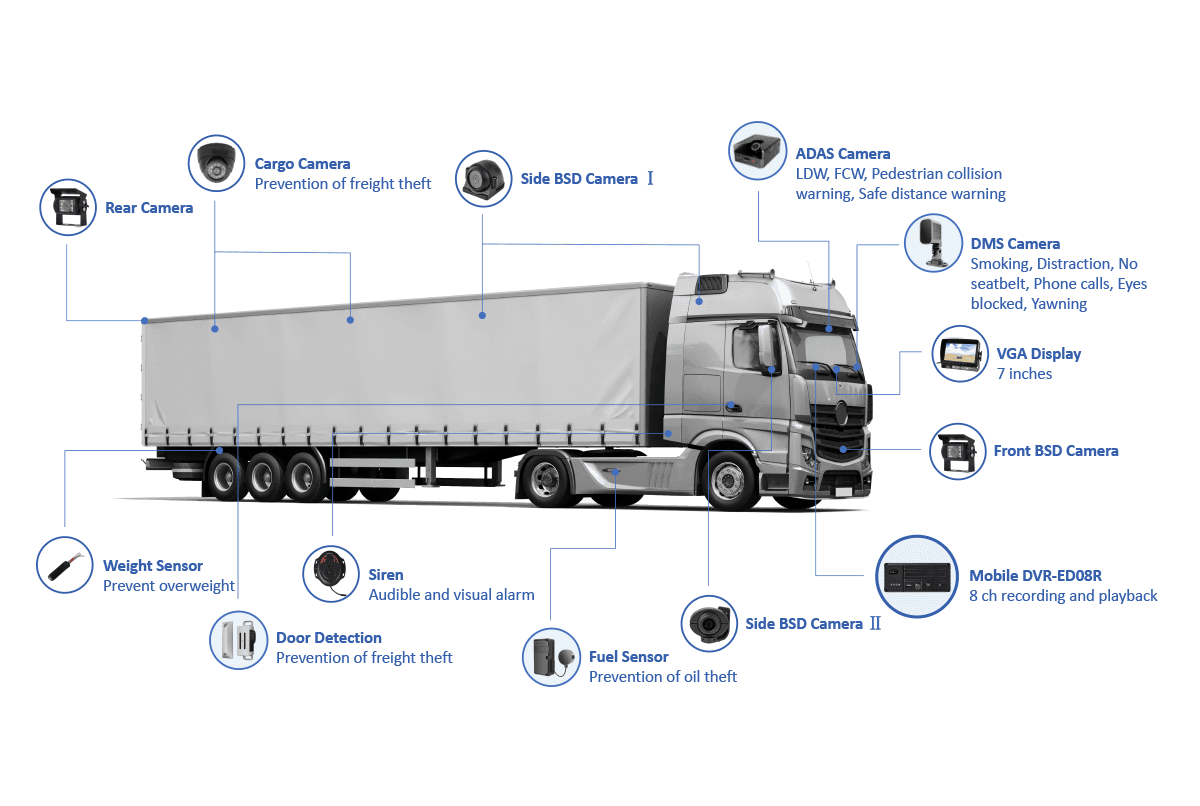
Install so footage is useful, not pretty:- Camera placement: prioritize driver view, right-side curb, rear loading area, and a blind-spot look.- Cable runs: keep video and power cabling separate from noisy electrical lines to avoid interference.- Test drive: validate footage quality at route speeds and in different lighting.- Maintenance: schedule periodic health checks and storage audits.Common mistakes: under-sizing storage, ignoring heat specs, and buying a DVR without reliable remote diagnostics. Those things bite you on day 30, not day 300.
Quick buying tiers — match to your fleet needs
Pick one of three practical tracks:- Basic: small fleets, short routes. 1080p cameras, single-SIM, local storage with easy retrieval.- Standard: medium fleets, mixed routes. H.265, dual-SIM, GPS, event locking, cloud access for incident download.- Advanced: large or high-liability operations. Redundant recording, CAN integration, encrypted cloud storage, and fleet-level device management.Choose the tier that solves your current pain points, then scale only where clear ROI exists.
Real-world context and credibility
Industry conversations at events like the Transport Logistic trade fair in Munich consistently show buyers shifting from one-off DVRs to integrated systems that combine video, telematics, and remote diagnostics. That trend reflects practical outcomes: fewer disputed claims, faster investigations, and measurable reductions in downtime when systems are maintained properly.
Final note
Pick a 4-channel mobile DVR that answers the problems you have today: reliable recording, smart storage, remote access, and easy maintenance. Match specs to real routes and staff skills, test in the field, and avoid one-off purchases. Many fleets end up using integrated platforms from BSJ because those solutions line up with operational needs instead of asking teams to change how they work.