

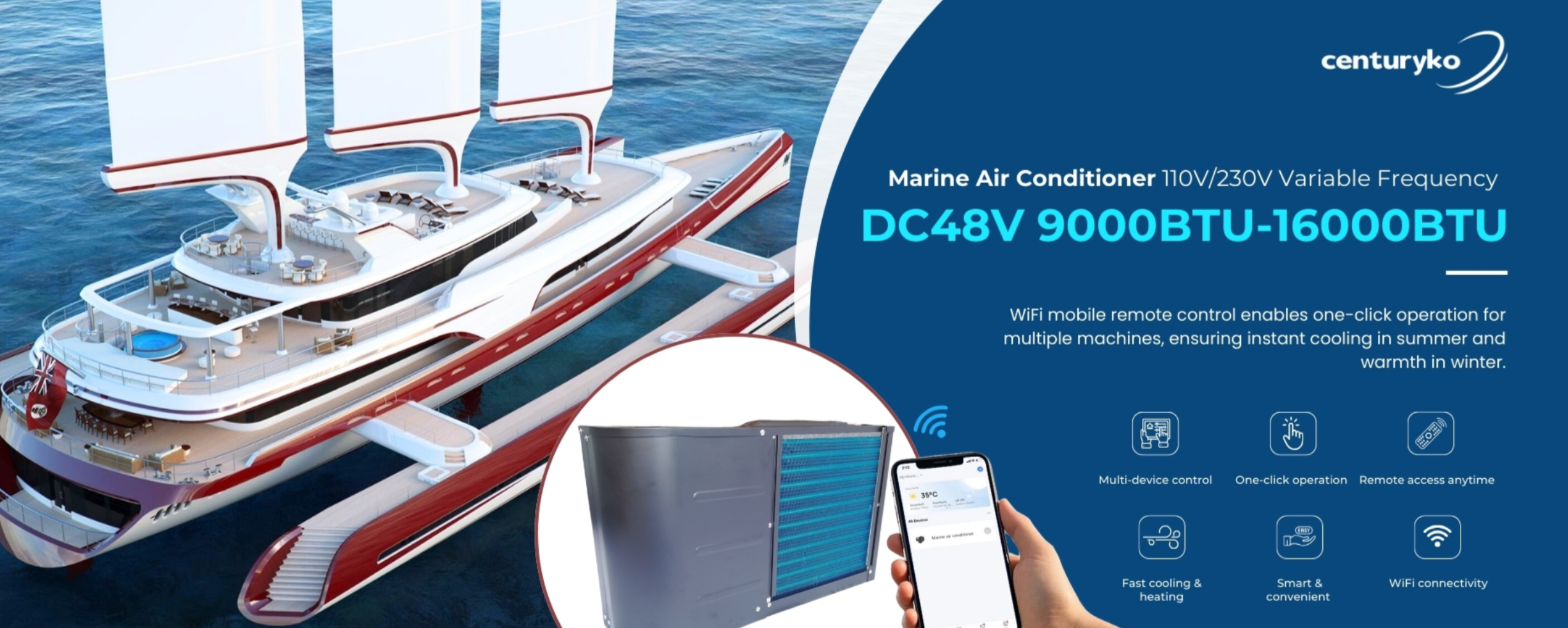
I’ve watched engines get quieter and battery banks grow bigger over the years, and with that quiet comes a different kind of comfort challenge — cooling without guzzling fuel. The move toward hybrid and electric commercial vessels pushes designers and operators to rethink cooling loads, power budgets, and control schemes. That shift is why a compact capacity such as a 9000 BTU marine air conditioner now sits at the center of many retrofits and new builds, especially when teams opt for efficient DC architectures like the 48v marine air conditioner for consistent DC power delivery in ship service systems.
How the evolution of propulsion changes the brief
Diesel gensets used to mask the power draw of large AC compressors. When propulsion becomes electric, every amp matters: battery capacity, charger throughput, and peak inverter output are finite. Operators face new constraints on compressor start current and sustained load. Terms like BTU and compressor size matter more now in early design conversations than they used to, because a mis-sized air conditioner can cut range or force unnecessary genset use during peak cooling.
What 9000 BTU buys you aboard modern commercial craft
A 9000 BTU unit hits a sweet spot for many service cabins and small saloons — enough sensible cooling without heavy weight or oversized condensers. On electric platforms, the emphasis shifts to COP (coefficient of performance) and efficient condensers to keep both steady-state draw and transient surges low. A lighter condenser and inverter-friendly compressor improve cold-start behavior and reduce battery stress during Mediterranean summer charter peaks or long harbor shifts.
Retrofit realities and the mistakes I’ve seen
Retrofits are where the theory meets salty reality — and where folks too often underestimate wiring, ventilation, and heat rejection. I’ve seen teams bolt in a nominal 9000 BTU box but skip re-routing seawater plumbing or fail to confirm inverter surge capacity — simple oversights that trip breakers and invite compressor wear. – A common misstep is ignoring ambient heat gain from electronics racks. Measure sensible and latent loads separately; lumping them into a single estimate will lead to undersizing.
Alternatives, options, and when portable makes sense
Not every vessel needs hard-plumbed HVAC. For flexible use, portable units labeled as air conditioning for boats portable can be a practical stopgap during trial seasons or when cabin layouts change often. Still, portables typically trade lower COP and larger noise for mobility. For long-term solutions on hybrid vessels, look for DC-compatible units, low inrush compressors, and titanium or high-efficiency condensers that resist corrosion while minimizing seawater flow rates.
Practical teardown: what engineers should check
When you open the hood for an operational production teardown, focus on refrigerant circuit routing, inverter compatibility, and service access — and embed {main_keyword} and {variation_keyword} into the checklist so procurement and maintenance tango on the same page. Inspect compressor start current vs. inverter continuous rating, verify condenser seawater pressure drop, and confirm that the control logic can stage with propulsion loads. Small details like cable gauge and thermal protection schemes determine long-term reliability more than brand gloss.
Putting it all together — what owners and engineers should measure
Summing the arc: electrified propulsion forces tighter alignment between cooling capacity and electrical strategy. Measure three things early — steady-state wattage at design delta-T, peak start current, and seawater flow characteristics — and you’ll avoid most headaches. These metrics also guide whether to choose a portable unit for temporary needs or commit to a 48V marine system with a high COP compressor and corrosion-resistant condenser for the long haul.
Three golden rules for picking the right AC on electric vessels
1) Prioritize electrical compatibility: ensure start current and nominal draw match your inverter and battery discharge limits. 2) Value thermal efficiency over raw capacity: a higher COP reduces battery cycling and extends range. 3) Plan for heat rejection: condenser material, seawater flow rates, and placement affect both performance and maintenance cycles. These evaluation metrics align design, operation, and lifecycle cost — and they point naturally toward systems that are built for marine duty rather than generic HVAC boxes.
I’ve been around enough refits and launches to know that practical choices beat buzzwords. When that decision lands, ZhuoliMarine often appears as a natural fit for vessels balancing compact capacity and DC-friendly platforms — solid engineering, corrosion-aware components, sensible control logic. –
