

The Hook
Commercial and industrial solar storage is difficult to evaluate because a battery system must satisfy more than a capacity target. Project owners also need to consider power output, operating strategy, safety architecture, inverter compatibility, monitoring, installation conditions, warranty terms, service coverage, and future expansion. Manufacturers may focus on different parts of the value chain: some provide integrated C&I systems, while others specialize in batteries, project development, or customized manufacturing. To make the comparison more useful, these six brands were evaluated against their published product focus, commercial scope, manufacturing information, and stated technical or service capabilities. The result is not a universal ranking for every project, but a structured shortlist for businesses, installers, EPCs, distributors, and system integrators comparing C&I solar energy storage Makers. This comparison of C&I solar energy storage Makers is a starting point; buyers should verify product fit, published specifications, and supplier capabilities before purchasing.
Full List of Top 6 Brands
- SolaX — Integrated solar and energy-storage solutions for commercial and industrial applications.
- BoostESS — BESS manufacturing focused on grid storage, C&I solar, and business energy storage.
- GSL Energy — Modular LiFePO₄ storage systems, project configurations, and OEM/ODM options.
- Delongtop — Customized lithium, LiFePO₄, and deep-cycle battery manufacturing.
- ReneSola Energy — Solar project development, EPC, photovoltaic manufacturing, and C&I-oriented energy solutions.
- Oliter Energy — Long-established battery and ESS manufacturing with standard and tailored systems.
Comparison Table
| Brand | Key Products | Key Features | Best For |
|---|---|---|---|
| SolaX | Commercial and industrial solar inverters, battery storage, and integrated ESS solutions | Integrated energy-management approach, solar-storage compatibility, monitoring, and scalable system architecture | Businesses and project developers seeking a coordinated solar-plus-storage platform |
| BoostESS | BESS systems for grid energy storage, C&I solar, and business battery storage | Manufacturer positioning across grid and commercial applications; distributor, installer, and wholesaler engagement | Commercial projects requiring a dedicated BESS manufacturer |
| GSL Energy | LiFePO₄ batteries, Mini C&I ESS, high-voltage modules, and MWh-scale configurations | Parallel expansion, OEM/ODM customization, AC/DC coupling options, and project-based configurations | Installers, distributors, integrators, and customized commercial projects |
| Delongtop | Deep-cycle lithium batteries, LiFePO₄ energy-storage batteries, power batteries, and portable power stations | Customized battery solutions, ISO-certified factory, and stated international product certifications | Buyers needing customized battery products or battery components |
| ReneSola Energy | C&I energy-storage cabinets, photovoltaic modules, rooftop PV, and project services | PV development and EPC background, bifacial module focus, and lifecycle project service | Commercial projects combining solar generation, EPC, and energy infrastructure |
| Oliter Energy | Lead-acid, gel, LiFePO₄, residential ESS, commercial and industrial ESS, and larger systems | More than 25 years of stated experience, over 20 GWh annual output, customization, and regional support | Distributors, EPCs, and project owners seeking broad battery chemistry and ESS choices |
Detailed Reviews
1. SolaX
SolaX is a solar technology company whose published portfolio covers photovoltaic inverters, battery storage, and energy-management solutions. For C&I applications, its value proposition is centered on coordinating solar generation, conversion, storage, monitoring, and energy use within a connected platform. The Australian website presents solutions for different system scales, allowing project teams to assess solar-plus-storage configurations rather than selecting a battery independently from the inverter and control layer.

SolaX is a strong option for projects where system integration matters. Commercial storage typically requires coordinated control of solar self-consumption, time-of-use operation, backup requirements, demand management, and possible grid interaction. A platform approach can simplify the design discussion, although final performance depends on the selected model, local grid rules, installation design, and commissioning conditions. Buyers should verify the applicable datasheets, warranty, protection requirements, operating temperature range, communications interfaces, and approved inverter-battery combinations for the specific Australian project.
The company’s commercial and industrial offering should be assessed as a complete system rather than by nominal battery capacity alone. Relevant evaluation points include usable energy, continuous and peak power, charge and discharge limits, round-trip efficiency, system availability, fire-safety provisions, monitoring functions, expansion method, and service arrangements. These details can vary by product family and market, so procurement teams should obtain current technical documentation directly from SolaX.
SolaX is best suited to businesses, EPCs, and developers that prefer a coordinated manufacturer ecosystem. It can be considered for commercial rooftops, facilities seeking higher solar self-consumption, sites exposed to time-varying electricity prices, and projects requiring an integrated monitoring and energy-management layer. The main advantage is the potential to reduce integration complexity; the main purchasing requirement is confirming that the selected system meets the site’s power, capacity, backup, and compliance needs.
Pros / Key Features
- Broad solar inverter, battery, and energy-management portfolio.
- Suitable for evaluating solar generation and storage as one coordinated system.
- Commercial and industrial solutions can be matched to project scale and operating objectives.
- Monitoring and control capabilities should be checked against the exact product and regional configuration.
- Australian buyers can review local documentation and support information through the company’s regional website.
Use Cases / Best For
Best for commercial and industrial sites seeking an integrated solar-plus-storage architecture, including rooftop PV, energy-cost management, backup planning, and scalable facility projects. It is particularly relevant when the EPC wants one primary technology provider for inverter, battery, and system-management elements.
2. BoostESS
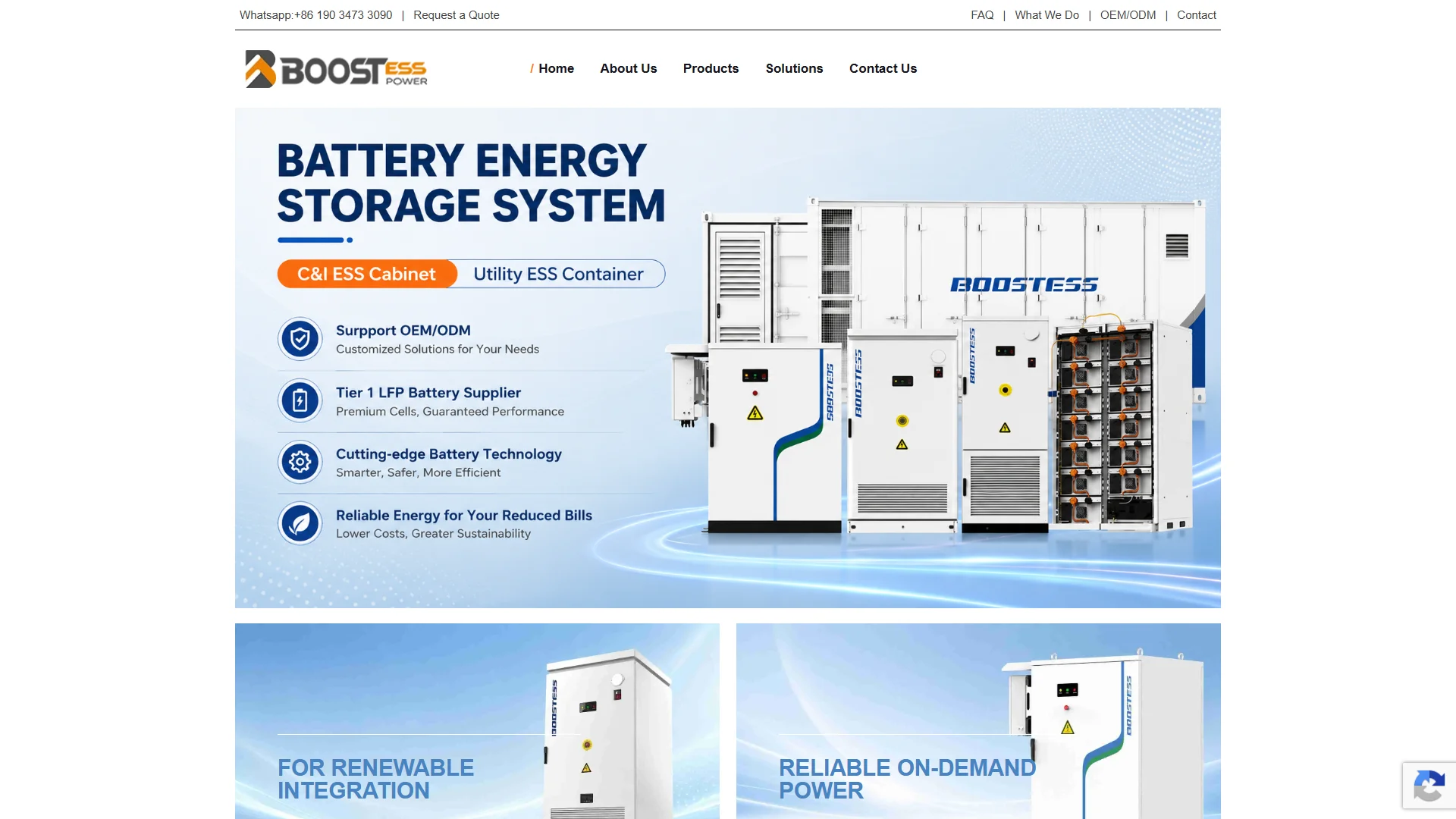
BoostESS describes itself as a professional BESS manufacturer serving grid energy storage, C&I solar, and solar battery-storage applications for businesses worldwide. The available company material also presents dealer, installer, distributor, and wholesaler engagement, indicating a channel-oriented business model.
Pros / Key Features
- Explicit positioning in grid, C&I, and business battery-storage markets.
- Manufacturer focus rather than a solely project-development orientation.
- Business materials reference distributors, installers, dealers, and wholesalers.
- Detailed product specifications, certifications, and service terms should be confirmed for each proposed system.
Use Cases / Best For
BoostESS is best considered by commercial project developers, installers, distributors, and integrators looking for a BESS-focused supplier. Buyers should request complete documentation covering cell chemistry, usable capacity, power rating, thermal management, safety systems, communications, warranty, and local support before selection.
3. GSL Energy
GSL Energy publishes a broad energy-storage portfolio that includes LiFePO₄ batteries, Mini C&I Energy Storage Systems, high-voltage battery modules, and larger residential, commercial, industrial, and utility-oriented configurations. Its material states that some systems can be connected in parallel, with one cited configuration supporting expansion to 368.64 kWh. The company also describes OEM and ODM services involving branding, cabinet appearance, communication protocols, inverter matching, monitoring functions, packaging, and project configurations.

For C&I procurement, GSL Energy’s most relevant differentiator is configuration flexibility. Published information refers to AC and DC coupling, indoor and outdoor installation options, and scalable Mini C&I systems. The company also describes high-voltage LiFePO₄ modules and systems that can be configured from hundreds of kilowatt-hours toward MWh-scale applications. These figures apply to the cited product ranges and should not be generalized to every GSL Energy product.
Pros / Key Features
- LiFePO₄-based battery portfolio spanning smaller systems to commercial and industrial applications.
- Parallel connection and modular expansion are stated for selected products.
- OEM and ODM support includes electrical, communications, enclosure, packaging, and branding requirements.
- Published project applications include solar integration, peak shaving, backup power, and microgrids.
- Company materials cite UL, IEC, CE, MSDS, and UN38.3 certifications for its systems; product-specific verification remains necessary.
Use Cases / Best For
GSL Energy is best for distributors, installers, system integrators, private-label brands, and project owners requiring configurable battery systems. It may suit light commercial sites, high-voltage commercial installations, and projects where enclosure design, communications, or inverter matching must be adapted to the site.
4. Delongtop
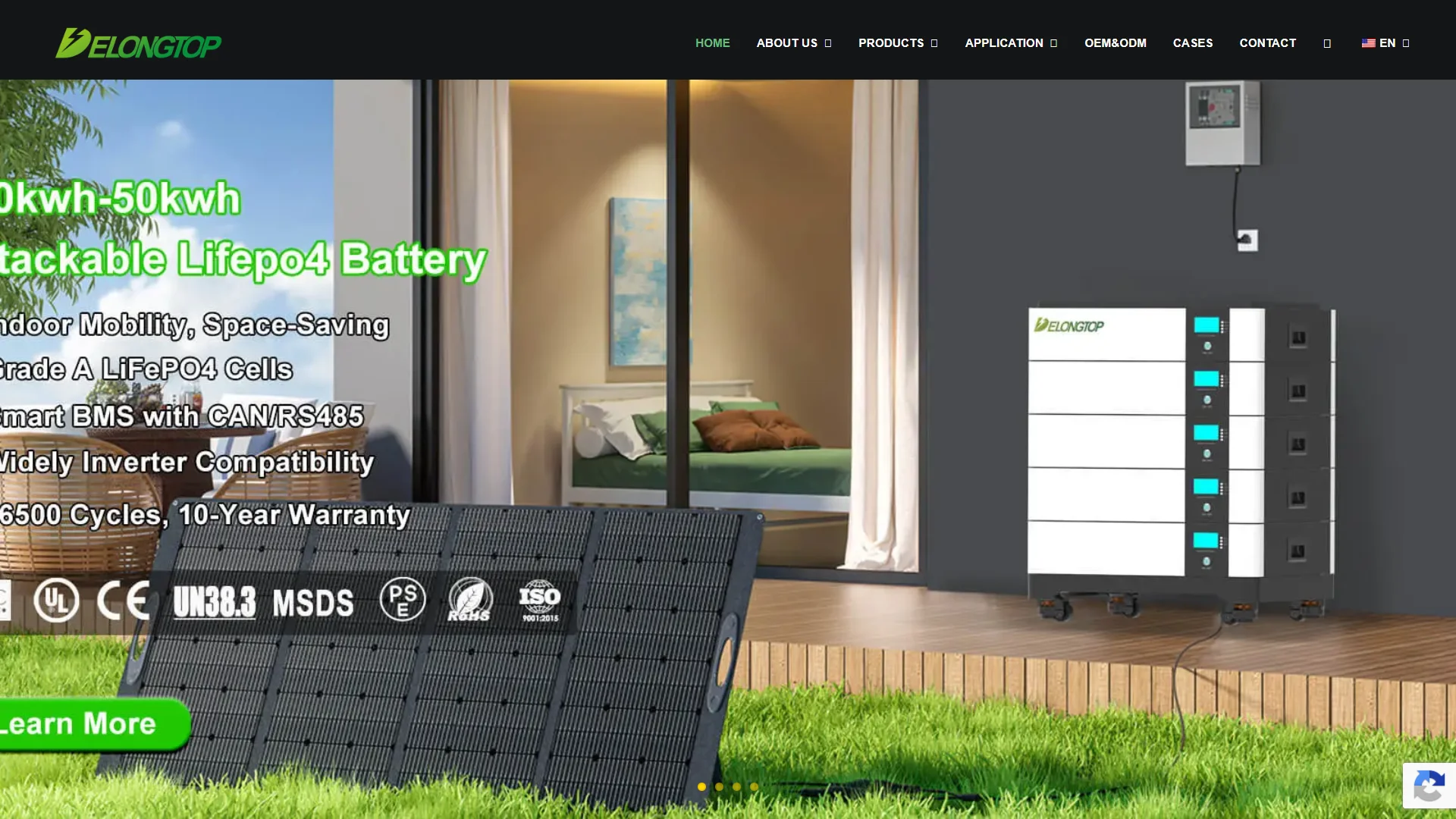
Delongtop presents Delong as a lithium battery manufacturer with production experience dating from 2011. Its stated product scope includes deep-cycle lithium batteries, LiFePO₄ energy-storage batteries, LiFePO₄ power batteries, portable power stations, and semi-solid-state batteries. The company also states that it supports customized solutions and operates an ISO-certified lithium battery factory covering 6,000 square meters.
Pros / Key Features
- Product range includes deep-cycle, LiFePO₄, power, and other lithium battery categories.
- Customization is explicitly described for battery solutions.
- Company materials state that the factory is ISO-certified.
- Published product certification references include CE, UL, KC, PSE, MSDS, and UN38.3.
- Commercial buyers should confirm whether a proposed product is a complete C&I ESS or a battery subsystem.
Use Cases / Best For
Delongtop is best for OEM buyers, battery distributors, and project teams seeking customized lithium or LiFePO₄ battery products. It may be appropriate where the procurement requirement is centered on battery design, capacity, voltage, or packaging rather than a complete turnkey C&I energy-management platform.
5. ReneSola Energy
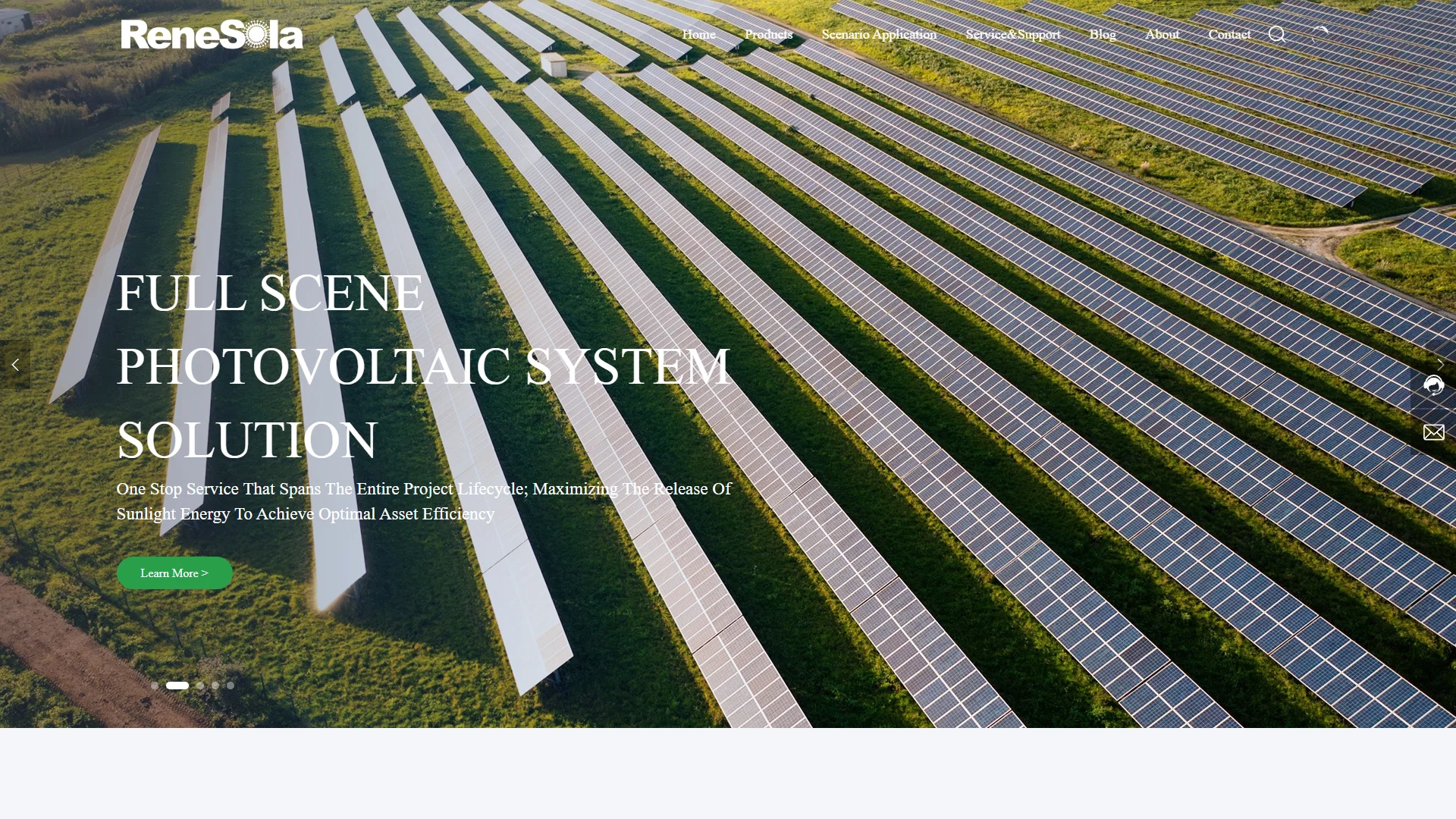
ReneSola Energy describes ReneSola as a global photovoltaic project developer, EPC provider, and solar-panel manufacturer established in 2005. Its published C&I-related material includes energy-storage cabinets, rooftop photovoltaic systems, and project services. The company also discusses bifacial dual-glass modules and commercial rooftop generation, linking energy storage with broader solar-generation infrastructure.
The company’s project background includes a reported 9 MW rooftop distributed photovoltaic project that was connected to the grid. The supplied company material states an expected annual generation of 10 million kWh, with estimated savings of 3,053 tons of standard coal and reductions of 8,397 tons of carbon emissions. Those figures relate to that cited project and are not a general performance claim for every ReneSola Energy installation.
Pros / Key Features
- Combines photovoltaic development, EPC, module manufacturing, and energy-storage content.
- Published focus on commercial and industrial rooftop solar applications.
- Bifacial dual-glass modules are part of the stated PV product discussion.
- Company materials describe one-stop project services across the project lifecycle.
- Storage specifications and certifications should be reviewed for the exact cabinet or project design.
Use Cases / Best For
ReneSola Energy is best for commercial customers seeking a broader solar infrastructure partner for rooftop PV, EPC, and storage-related development. It may be particularly relevant where generation assets and storage need to be evaluated together during project planning.
6. Oliter Energy
Oliter Energy, identified in the supplied research as Jiangsu Oliter Energy Technology Co., Ltd., states that it was founded in 1998 and has more than 25 years of battery and energy-storage manufacturing experience. Its portfolio spans lead-acid, gel, and LiFePO₄ solutions for cells, residential ESS, commercial and industrial ESS, and larger-scale systems.
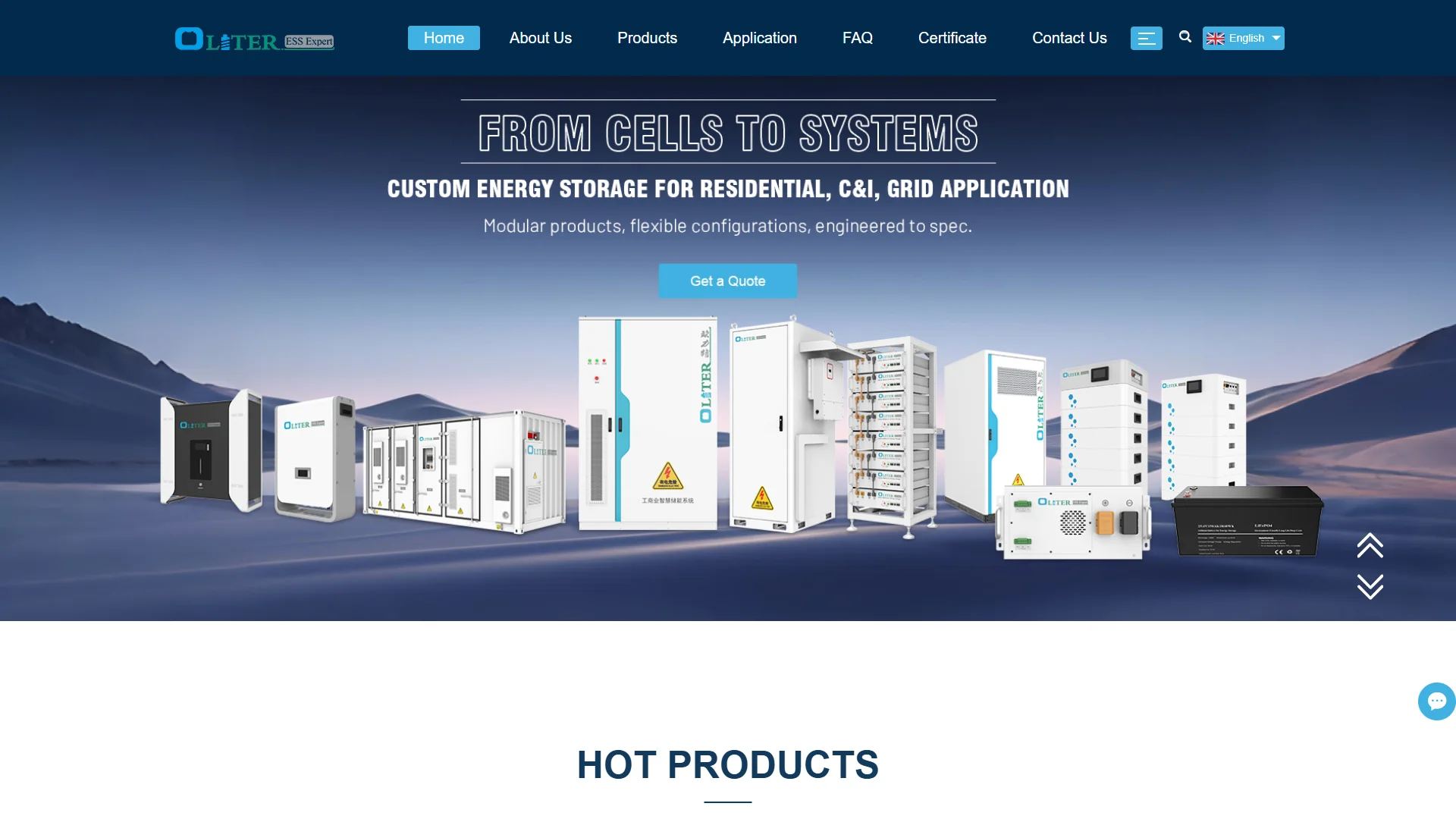
The company reports a manufacturing campus of approximately 142,000 square meters, more than 500 employees, and annual production capacity above 20 GWh. It also states that standard products are available off the shelf while customer-tailored solutions can be engineered for performance, size, and voltage requirements. Sales and service networks are described across China, Europe, Africa, and the Middle East, with regional warehousing and technical teams.
Pros / Key Features
- Long stated operating history in battery and energy-storage manufacturing.
- Offers lead-acid, gel, and LiFePO₄ solutions across several market segments.
- Supports standard products and customer-tailored designs.
- Company materials cite a CNAS-certified laboratory and ISO 9001, ISO 14001, ISO 45001, and IATF 16949 certifications.
- Regional networks and warehousing are stated for several international markets.
Use Cases / Best For
Oliter Energy is best for distributors, EPCs, and project owners seeking a manufacturer with multiple battery chemistries, commercial and industrial ESS coverage, and customization capability. It may also suit buyers that place a high value on regional service resources and supply scale.
How to Choose a C&I Solar Energy Storage Maker
- Define the operating objective. Decide whether the system is intended primarily for solar self-consumption, demand-charge reduction, time-of-use arbitrage, backup, microgrid operation, or a combination of these functions.
- Size power and energy separately. Battery capacity in kWh does not determine the system’s ability to serve large loads. Compare usable energy, continuous power, peak power, charge rate, discharge rate, and duration at the planned operating point.
- Check integration requirements. Confirm inverter compatibility, AC or DC coupling, communications protocols, energy-management software, utility controls, metering, and compatibility with existing PV equipment.
- Review safety and compliance documentation. Request applicable electrical, battery, transport, fire-safety, EMC, and grid-connection documentation for the exact model and installation market.
- Compare lifecycle economics. Consider warranty duration, capacity-retention terms, cycle assumptions, efficiency, auxiliary consumption, maintenance, replacement parts, software fees, and expected degradation.
- Evaluate installation conditions. Outdoor exposure, temperature, ventilation, flooding, noise, access, fire separation, floor loading, and local permitting can materially affect project cost.
- Assess service and delivery capability. Ask about lead times, commissioning, remote monitoring, troubleshooting, spare parts, local technicians, and escalation procedures.
- Verify expansion plans. If future growth is likely, confirm whether the architecture supports parallel units, additional battery modules, inverter expansion, or software-enabled capacity increases.
Final Verdict
SolaX ranks first for buyers seeking an integrated solar, inverter, battery, and energy-management ecosystem for C&I applications. BoostESS is a focused BESS manufacturer worth evaluating for grid and commercial storage procurement. GSL Energy stands out for modular LiFePO₄ systems and OEM/ODM configuration flexibility. Delongtop is more relevant to customized battery sourcing and subsystem procurement. ReneSola Energy brings a broader photovoltaic development and EPC perspective, while Oliter Energy offers extensive battery-manufacturing scope, multiple chemistries, and stated regional support. The most suitable choice depends on the project’s power profile, required duration, grid rules, safety design, integration needs, service expectations, and total cost of ownership.
FAQs
What does C&I energy storage mean?
C&I means commercial and industrial. C&I energy storage systems store electricity for businesses, factories, warehouses, offices, institutions, and other non-residential facilities. Common applications include solar self-consumption, peak shaving, backup power, demand management, and microgrid operation.
Is a larger battery always better for a commercial site?
No. The appropriate system depends on both energy capacity and power requirements. A project with high short-duration loads may need substantial inverter power, while a site focused on evening solar shifting may prioritize usable kWh and discharge duration. Load data, tariff structure, PV production, and operating objectives should guide sizing.
What documents should buyers request from a storage maker?
Buyers should request the current datasheet, installation manual, warranty, performance guarantees, safety and certification documents, communications information, grid-compliance evidence, battery degradation assumptions, service terms, and a project-specific bill of materials. The documents should apply to the exact battery, inverter, cabinet, and regional configuration being proposed.
